
Dynamic design & history
The park, which opened in 2007, was designed by landscape architect Tom Oslund to create an open space adjacent to two Minneapolis landmarks, the Guthrie Theater and the Mississippi River. Gold Medal Park is the first substantial green space added to downtown Minneapolis since two city parks were built in 1883 and West River Parkway was expanded in the 1990s.
In 2014, the Conservancy purchased the majority of the parkland owned by the Guthrie, then secured a 50-year lease for the rest of the land, owned by the City of Minneapolis. An agreement with the city defines the Conservancy’s continuing maintenance responsibilities. Between 2015–2017, four sculptures from the Walker Art Center’s Sculpture Garden were relocated to the park.
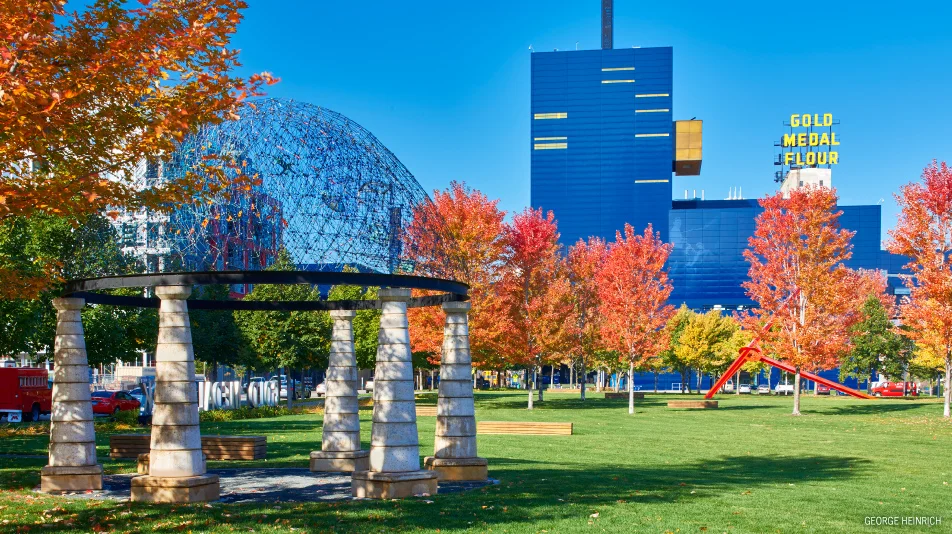
In this stone and steel-mesh sculpture, Hatcher melds the logic of an engineer with a visionary’s impulse to transcend time and space. A futuristic dome, made of thousands of wire polyhedrons, rests atop Egyptian columns. An assortment of objects, including a chair, a turtle, numbers and letters, hover within the dome: private symbols that the artist offers for universal contemplation. Source: Walker Art Center website.
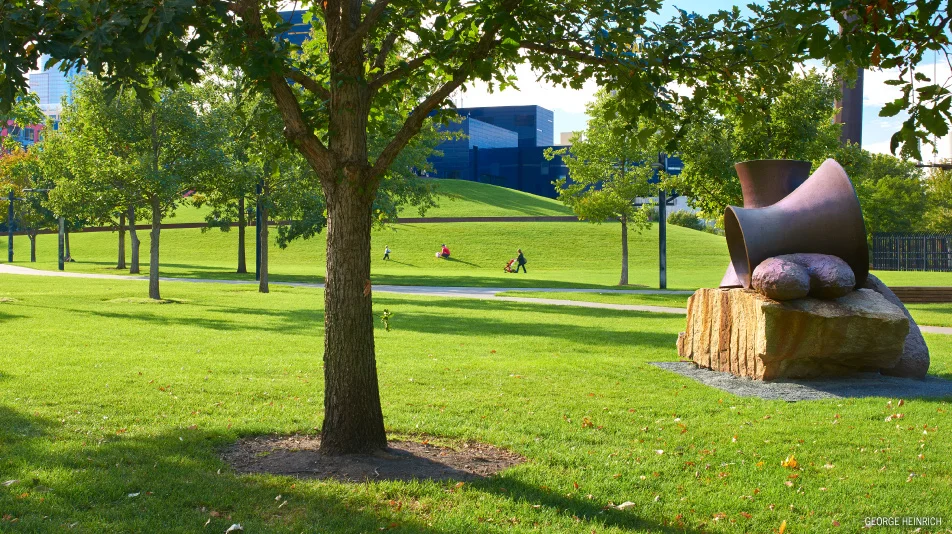
The scientifically trained artist Tony Cragg transforms two smooth-surfaced, concave, cylindrical forms and two elemental, biomorphic shapes into a complex meditation on time and technology. During the Ordovician geological era, 500 million years ago, oxygen gave rise to terrestrial life, while killing off the algae species that produced it. The cylinders’ resemblance to nuclear plant cooling towers may suggest an analogous life-death conundrum. Source: Walker Art Center website.
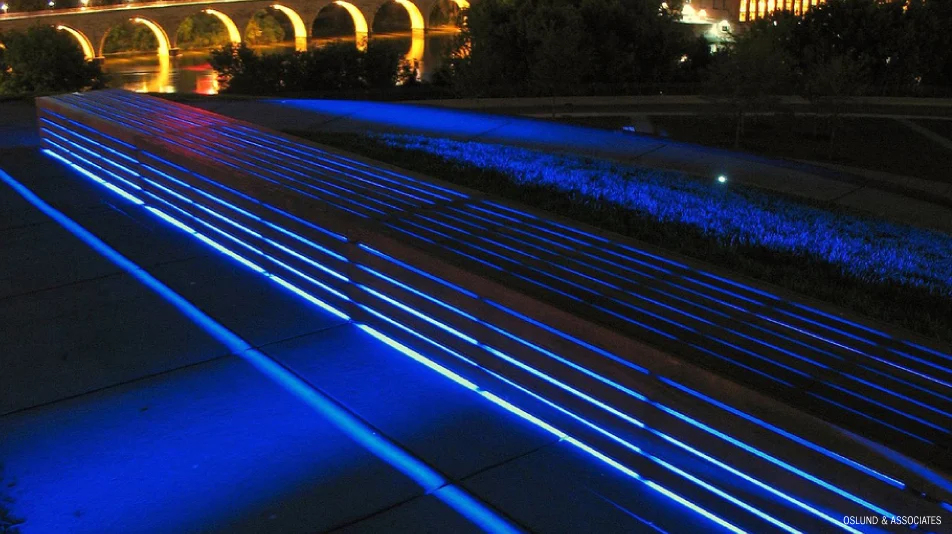
Twenty custom-designed, handcrafted benches line the edges of the park, creating places to rest, appreciate the view, or enjoy a lunch break. Blue LED lights cause the benches to glow from within, during the evening hours. The effect adds a uniquely ephemeral quality to the park at night. Source: Oslund and Associates, www.oaala.com
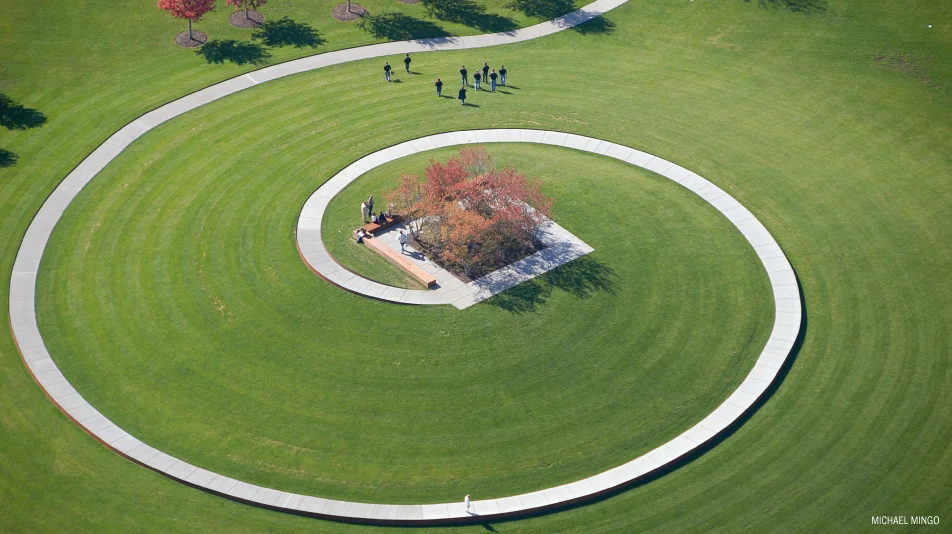
Park visitors reach the 32-foot-high (9.8 m) mound by a spiral walkway, rising out of a green lawn. The mound takes its inspiration from traditional Dakota Indian burial mounds, found throughout Minnesota. Source: Oslund and Associates, www.oaala.com
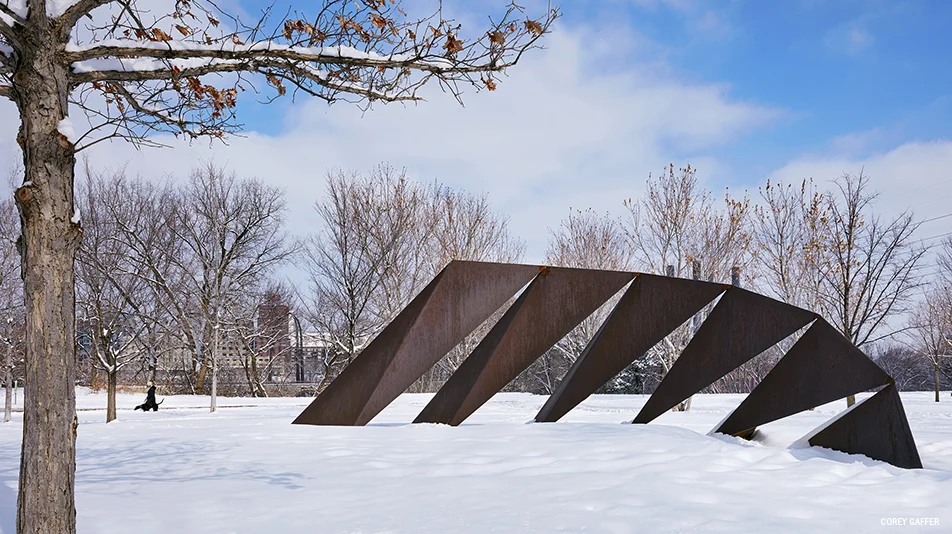
The design for Charles Ginnever’s mammoth steel sculpture was inspired by one of nature’s unique primitive structures: the spiraling, chambered shell of the marine mollusk known as the nautilus. To understand its spatially complex form the viewer must circle around the piece, tracing the spiral motion of the progressively sized chambers to discover the secret of its design: six flat parallelograms, folded at regularly increasing intervals, that are welded together. The changing light and seasons interact with the sculpture’s surfaces to create subtly shifting visual effects. Source: millcitytimes.com
Press About the Park
LandscapeOnline.com, Gold Medal Design at Gold Medal Park

A pair of enormous, red-painted steel beams meet at their ends, creating an alarmingly improbable triangle. A longer beam forms the third leg of the tripod, jutting some 38 feet into the air. Three flat, centerless discs unify the junction. The effect of this characteristic work by di Suvero evokes the force we attach to the atomic world: dynamic, red-hot, powerful, and strangely elegant. Source: Walker Art Center website.